Beverly Kleiber comes from a line of fabulous artists. Her grandfather was an artist during America’s pioneer days. He spent a lot of time with natives in Wyoming during the early days of the last century. So no wonder she became such an amazing talent. Ever curious and lively, she was one of the very first artists to embrace digital art. This was especially remarkable, since in the early days of digital art, it was necessary to code to create art. Beverly Kleiber, whether working with watercolors, oils, acrylics, glass, or creating digital animation or code, always pushes the envelope.
Here is an article and a few videos Beverly Kleiber contributed to www.riovida.net for your enjoyment.
Leonardo – one of the first magazines devoted to digital art
Beverly Kleiber served on the Board of Directors of Leonardo, a magazine devoted to advancing and highlighting digital art. During 2024, she reflected on her experience.
The emerging technologies were still undefined. The horizon seemed limitless. Hopes for the World Wide Web were indeed more romantic than real. It was a time of first love; we could fill in between the fuzzy lines with whatever dreamscape we desired. Despite the dystopian scenarios spun by sci-fi authors like Phillip K. Dick, my fuzzy lines were generally dusted with heat lightning out of a prairie storm mixed with pixie dust [1].
“For me (Color Plate D), it was the Amiga 1200 computer (1992). While the graphics were a triumph of imagination over gritty pixels, the fully populated RAM made interaction with humans fast enough to keep attention from fading. The Amiga computer, with its Mandela software, made interactive narratives possible. I created stories with multiple endings that depended on choices made by the participant earlier on the decision tree. I emphasized the power of…”
It was a Time of Naïve Enthusiasm
The emerging technologies were still undefined. The horizon seemed limitless. Hopes for the World Wide Web were indeed more romantic than real. It was a time of first love; we could fill in between the fuzzy lines with whatever dreamscape we desired. Despite the dystopian scenarios spun by sci-fi authors like Phillip K. Dick, my fuzzy lines were generally dusted with heat lightning out of a prairie storm mixed with pixie dust [1].
Coming of age as an artist when the tools for interactive multimedia first became widely available, I became a pioneer of walk-in immersive environments, cobbling connections between computers, cameras, and sound devices. It was a time of rapidly expanding media, and a loose cohort of intrepid artists known as YLEM/Artists Using Science & Technology, founded in 1981 in San Francisco, possessed the temerity to attempt a new story [2]. Below, I discuss a few of these artists who I consider groundbreakers and game-changers in the wilderness of art and new technologies in the 1990s. To better understand these artists and the churning lava pool that stirred their imaginations, I asked them the following questions:
What do you think were the most significant inventions of the 1990s?
How did they enable your artwork? Or not?
Analog and Digital Intersecting in the Smoke
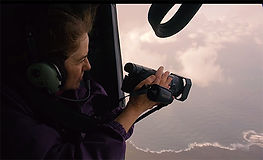
I always picture Jody Gillerman hanging out of a small plane over a lava flow or smoking volcano with her video camera dangling out the window (Fig. 4). Mind you, I never actually saw this, but the beauty and drama of her images plus the physical interaction of her installations made it seem so.
Jody followed eclipses, eruptions, and flows all over the globe to capture source material for her installations. One of these interactive installations, Shadow Dance, allowed visitors of all ages to interact with eclipses using their feet on floor-sensor controllers.
Fig. 4: Jody Gillerman, hanging out of the window of a helicopter, captures video of a volcano for one of her projects. Photo courtesy of Jody Gillerman. (© Jody Gillerman. Photo: Mick Kalber.)
Jody’s answer on how the significant inventions of the 1990s enabled her work:
“Video” goes digital! Video and Computers finally on symbiotic ground! Coming from a Fine Arts background in painting, drawing and printmaking, I love analog—specifically analog patch-programmable video processing/synthesis. Having personally built a video synthesizer, that established my entry into what seemed to be a unique video and computer graphics screen-based arena. However, surprisingly to me, prior to the ’90s, video/analog and computers/digital were two different worlds, very far apart, not easily merged.
“Digital Video” opened new doors. Interdisciplinary integrations were not easily possible prior to this. Coupled with new digital arts creation and distribution media (CDROM/DVD) and a newly forming internet with search engines, media arts integration and accessibility provided new digital landscapes, expanded avenues for creation, reach, distribution and accessibility. The intersection of analog and digital technologies provided exploration and new directions for my creating interdisciplinary interactive arts, interactive storytelling, and personally pressed media-based interactive CD-ROM/DVDs.

Leonardo was founded in 1968 in Paris by kinetic artist and astronautical pioneer Frank Malina who saw the need for a journal to serve as an international channel of communication among artists, with emphasis on the writings of artists who use science and developing technologies in their work. Published by The MIT Press, Leonardo has become the leading international peer-reviewed journal on the use of contemporary science and technology in the arts and music and the application and influence of the arts and humanities on science and technology.
Leonardo is interested in work that crosses the artificial boundaries separating contemporary arts and sciences. Featuring illustrated articles written by artists about their own work as well as articles by historians, theoreticians, philosophers and other researchers, the journal is particularly concerned with issues related to the interaction of the arts, sciences and technology. Leonardo focuses on the visual arts and also addresses music, video, performance, language, environmental and conceptual arts—especially as they relate to the visual arts or make use of the tools, materials and ideas of contemporary science and technology. New concepts, materials and techniques and other subjects of general artistic interest are covered, as are legal, economic and political aspects of art.
Leonardo articles are indexed on and ranks third among Visual Arts titles on Google Scholar(link is external). See a full list of services that abstract and index(link is external) Leonardo on The MIT Press website.