
Stephen Bannon and the people he promotes in Breitbart want to bring the Nazi Era back
Slave labor was celebrated by the Nazi’s and the US prison system is already overloaded. The Colorado support for Slavery, literally and legally, is a bad omen.
To simply assume that “Labor Prison Camps” can’t happen in the US is the easy way out, since there are already exist today and have since forever. For instance, in a CNN Money report we found that Barrett, 36, sued the Florida Department of Corrections for negligence after an mentally ill prison mate gouged out one of his eyes. The department responded with a “cost of incarceration lien” of $54,750 — the total cost of Barrett’s 1,095 day stay in the prison at $50 a day. “They charged me for me being in prison,” Barrett said. “Yeah I was surprised.” Dee Taylor, was released after serving a three-year bid in various Florida prisons, he also got a bill for around $55,000 from the Florida Department of Corrections. A recent report from the Brennan Center for Justice at the New York University School of Law found that these types of fees, where inmates can be charged for room and board, have been authorized in at least 43 states. In 2014, for example, an appellate court in Illinois ruled that a Chicago inmate named Johnnie Melton would have to pay nearly $20,000 to the Illinois Department of Corrections for the cost of his incarceration.
In Arizona, an inmate’s friends and family can be charged $25 just to visit them. In 35 states, facilities can charge inmates for medical services. Some of these charges can be taken directly out of a prisoner’s commissary account while the person is still incarcerated. In some cases, the commissary account itself is subject to fees. CNN
Why should we care?
Currently prisoners in Colorado work for 60 cents a day, clearly way below the minimum wage. This is legal in Colorado, in fact they could work for no pay, since slavery inside a prison is still legal in Colorado, and confirmed in the November 2016 election.
This is breaking families apart because some children have to pay $1/minute to talk to an incarcerated parent. Why? Because prisons and jails profit by granting monopoly telephone contracts to the company that will charge families the most. In Colorado for $55 a night, the wives, mothers and children of Prison Valley inmates often stay at the Riviera motel in Florence. Dabrowska is a gentle house mother to families in need — for women like one named Joy, who for years came to visit Kaczynski until she died of cancer. Prisons are big business for instance in a security advertisement by Securus it is stated that investing in Prison Services is great business. Echelon was founded in 1996 started in the first year with $0.1 profit and when public in 2006 with a profit of $41 Million. This telephone company that overcharged the poorest of the poor – namely the families that are left behind by prisoners was sold in 2007 for $708 Million dollars. Not bad for 10 years of work. Now Robert E. Pickens is expanding his reach as president of Securus. Securus has 2,600 customers (prisons) in 46 states. They recruit investors by explaining that they are in a recession proof $78 Billion dollar industry. They explain that their EBITDA (Earnings before interest, tax, depreciation and amortization) grew by 274% from 2007 to 20014. Amazing growth or earnings indeed! They promise that they will experience organic growth through numerous initiatives that are already underway.
From a press release from Securus from April 30, 2014 we learn:
“Richard A. (“Rick”) Smith, current President and Chief Executive Officer announced today the promotion of Robert E. Pickens, Chief Operating Officer to President of Securus Technologies effective May 1, 2014. Mr. Smith will retain the Chief Executive Officer title. “I have worked with Mr. Pickens for over 15 years – in the telecommunications, telecom systems, and high tech government services sectors and he possesses the positive attributes of commitment to the firm, a high level of business integrity, business intellect, and the ability to get results over long periods of time,” said Smith. Mr. Smith continued, “At Securus, Mr. Pickens held the positions of Vice President of Marketing and Chief Operating Officer, and also held these same positions at the previous company Eschelon Telecom, Inc. – a Minneapolis, Minnesota competitive local exchange carrier where he and I worked together for approximately nine (9) years. Because of our tenure working together, I am sure that Mr. Pickens will continue to deliver good results as a higher level executive. “We have completed nine (9) strategic acquisitions of assets, patents, technologies, and companies over the last twenty-four (24) months – and Mr. Pickens represents a perfect match for effectively managing this expanded set of entities and assets along with his classic Securus responsibilities.” Securus Technologies, Inc. is one of the largest providers of detainee communications, parolee tracking, and government information management solutions, serving approximately 2,600 correctional facilities in 46 states, the District of Columbia, Canada, and Mexico, and more than 1,000,000 inmates. A recognized leader in providing comprehensive, innovative technical solutions and responsive customer service, Securus’ sole focus is the specialized needs of the corrections and law enforcement communities. Securus is headquartered in Dallas, Texas, including four regional offices in the Dallas metro area as well as one in Atlanta, Georgia. For more information please visit the Securus website at www.securustech.net.
Peter Wagner an expert on the prison system tells us: “There are 3,283 jails in America, yet jails receive scant attention. The legislative, judicial and executive decisions that have fueled the explosion of our state prison populations are becoming well-known; but the myriad of subtle policy decisions that have sent our jail populations upwards are off the public’s radar.
For instance do you know that capturing innocent people, keeping them in jail for a while before giving them a hearing, after which they are released is BIG, BIG business? In the U.S., which has the largest pretrial detention population in the world, 20 percent of detainees eventually had their case dismissed or were acquitted. According to American Quarterly. Being imprisoned often comes with a very high price. The U.S. has estimated that at least 13 percent of inmates have been sexually assaulted. Too often, jails and prisons across the Americas have become warehouses for individuals who are undereducated, unemployed, addicted to controlled substances, and/or have medical or mental health needs.
Racial Bias in the Prison System is now computerized
The Sentencing Reform and Corrections Act of 2015 was introduced in the United States Congress and both Republican and Democratic senators backed the ambitious bill. A proposed program instructs the U.S. attorney general to establish what the bill calls a “post-sentencing risk- and needs-assessment system” for federal prisoners, which would assign inmates a low, moderate, or high score based on their likelihood of recidivism. “Dynamic risk factors”—including “indicators of progress and improvement, and of regression, including newly acquired skills, attitude, and behavior changes over time”—would determine the ratings. The language of the bill indicates that an inmate’s score will affect housing assignments, telephone and visitation privileges, and be consulted in making assignments to anti-recidivism programs like vocational training, faith-based programming, and drug- and alcohol-recovery classes. Those who are considered low-risk inmates are eligible for reduced sentences would receive 10-days credit for every 30 days of successful participation, while other “high-risk” inmates receive only 5 days credit.
The very concept of predicting crime challenges the presumption of innocence, a central tenet of the American criminal-justice system.
Police still patrol streets and knock on doors, but computers, rather than humans, decide which streets and which doors. Essentially, this is crime forecasting: Police are trying to stay ahead of potential criminals, who may or may not be about to violate the law.
The trouble with this bill is that it has racial bias built into a system that is sure to create the proof of this racial bias. “The categorical exclusion of over half the prison population is unwarranted, and would have a disparate impact on African American and Native American inmates. Risk factors correlate with socioeconomic class and race, and studies show that African Americans are more likely to be misclassified as high risk than White or Hispanic offenders. The exclusion is also contrary to the goal of increasing public safety. Many of the excluded inmates have the greatest need to participate in programming, but would have no meaningful incentive to do so. With or without time credits, they will serve lengthy sentences and then be released. By failing to encourage them to participate in programs shown to reduce recidivism before releasing them to the community, S. 467 fails to promote the stated goal of enhancing public safety. ” Federal Defender Analysis Report Source: Atlantic Monthly
If you can’t afford bail you will be rated worse than if you can, even if you are innocent.
Prisoners who are let go due to the fact that they are innocent still get charged the cost of incarceration fee.
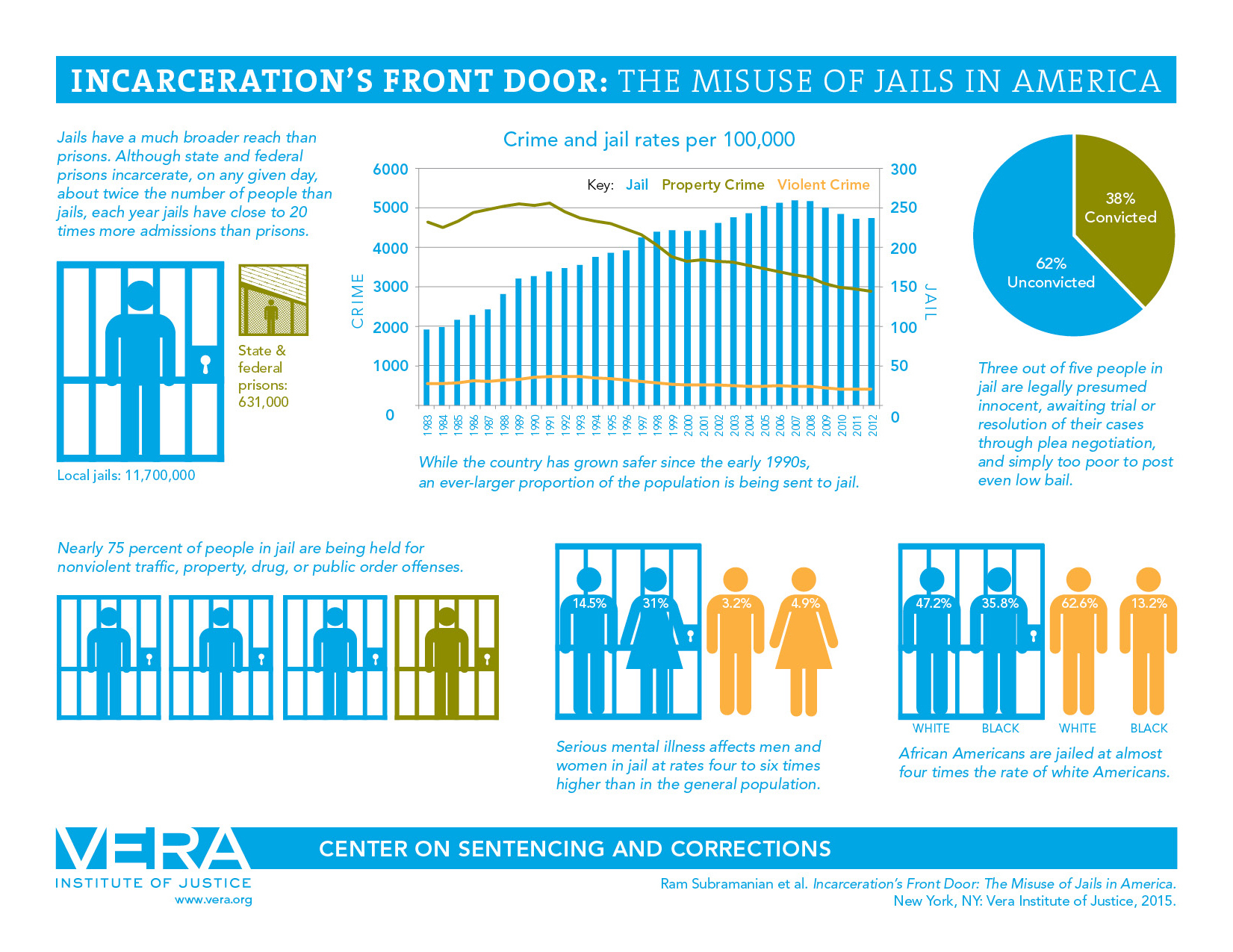
Currently 3 out of every 5 people in jail are unconvicted and are presumed innocent, they are there because they are too poor to post bail while they await their trial.
The Prison and Labor Camp Industry is thriving
The LA Times reported in 2015 that in the place known as Prison Valley, Colorado is home to 11 state and federal lockups, more than 7,500 inmates do time near two communities that have the feel of college towns — an odd coupling that can create tension and conflict perhaps found nowhere else in America. Fremont County (population 46,000) has Colorado’s biggest per capita population of prison inmates, a rate that’s also one of the nation’s highest.
The United States Holocaust Museum tells us:
From its rise to power in 1933, the Nazi regime built a series of detention facilities to imprison and eliminate so-called “enemies of the state.” Most prisoners in the early concentration camps were German Communists, Socialists, Social Democrats, Roma (Gypsies), Jehovah’s Witnesses, homosexuals, and persons accused of “asocial” or socially deviant behavior. These facilities were called “concentration camps” because those imprisoned there were physically “concentrated” in one location.
Between 1933 and 1945, Nazi Germany and its allies established more than 40,000 camps and other incarceration sites. The perpetrators used these sites for a range of purposes, including forced labor, detention of people thought to be enemies of the state, and mass murder. The total number of sites is based upon ongoing research in the perpetrators’ own records.
Millions of people were imprisoned and abused in the various types of Nazi camps. Under SS management, the Germans and their collaborators murdered more than three million Jews in the killing centers alone. Only a small fraction of those imprisoned in Nazi camps survived.
Isn’t it time that we start paying attention?